Epoxy vs polyaspartic garage floor coatings
Epoxy and polyaspartic coatings are not always competing choices. They can perform different jobs within the same garage floor system.
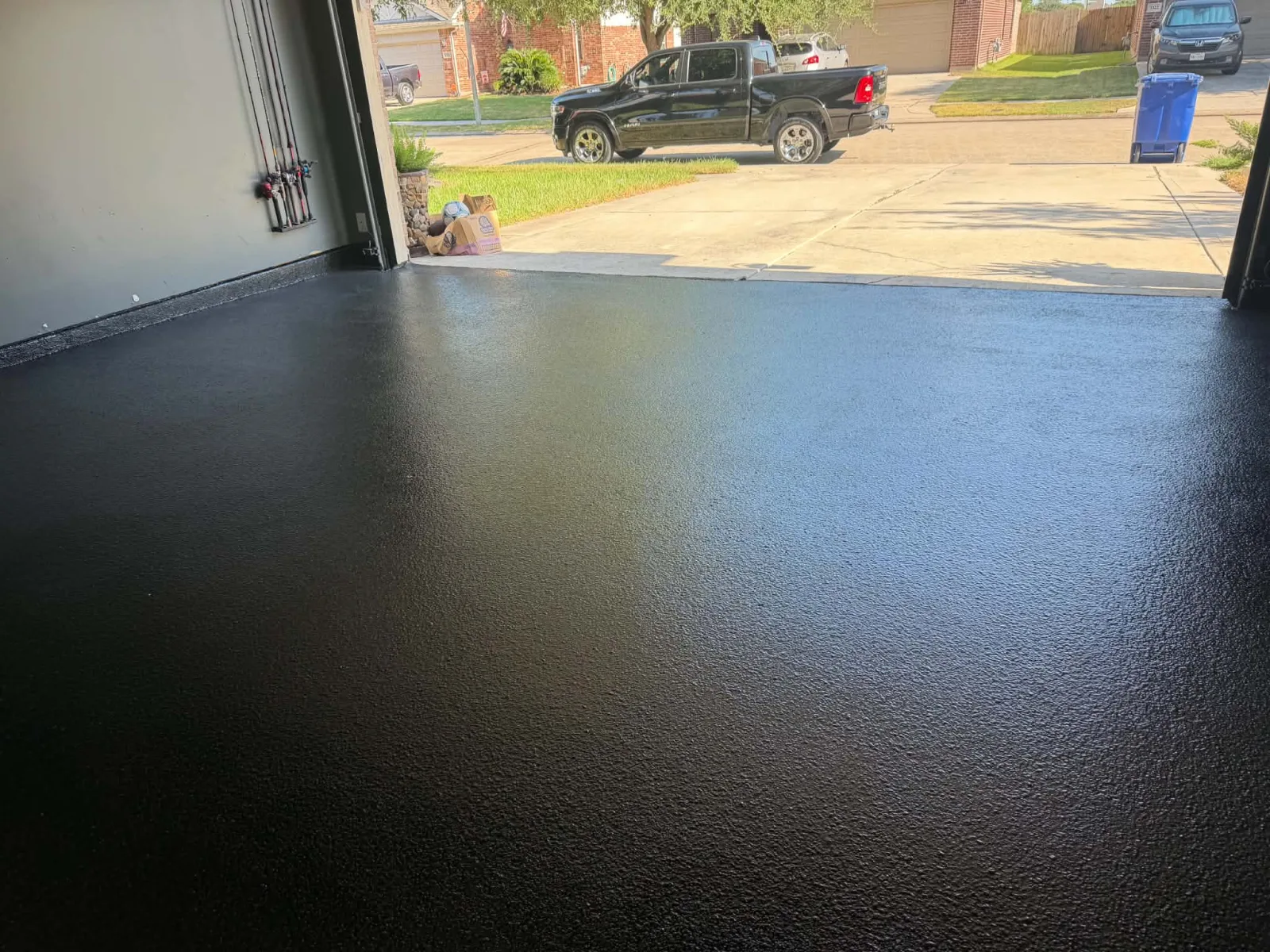
Homeowners often ask whether epoxy or polyaspartic is the better garage floor coating. That question leaves out an important detail: a professional floor is an assembly of layers. A system can use epoxy for build and decorative broadcast, then use polyaspartic as the protective topcoat.
The practical answer: compare the complete system, not one product name. Ask what is being used for the primer, base coat, decorative broadcast, and topcoat.
What epoxy does in a garage floor system
Epoxy coatings are commonly used as primers, build coats, and pigmented base coats. Simiron 1100SL is a two-component, 100% solids, high-build epoxy that is compatible with decorative chip and quartz broadcasts. In a flake system, the wet base coat receives the decorative material before the protective topcoat is installed.
Epoxy also has a defined working time, recoat window, and cure schedule. Those times change with product selection and site conditions, so the installer must plan the layers as one connected process.
What polyaspartic does in a garage floor system
Simiron Polyaspartic HS is a two-component aliphatic polyaspartic coating designed for full-broadcast floor systems. Simiron lists garages, auto service areas, exterior areas, and areas exposed to ultraviolet light among its recommended uses.
As a topcoat, it seals the broadcast layer and provides the finished wear surface. Simiron identifies UV stability, abrasion resistance, chemical resistance, and multiple cure speeds among the product’s characteristics.
Why the answer is often both
Simiron’s Simflake SB guide documents a decorative floor assembly with a prepared concrete substrate, epoxy primer, 1100SL epoxy base coat, decorative chip broadcast, and Polyaspartic HS topcoat. Other Simiron products can be used in alternative assemblies, but this example shows why the choice is not always epoxy or polyaspartic.
Each layer has a specific job. Changing one layer can change application conditions, film thickness, recoat timing, return to service, and the final texture.
| Coating | Common role in a flake system | Questions to ask |
|---|---|---|
| Epoxy | Primer, build coat, or base coat that receives decorative chip | Which product, surface profile, moisture limits, and recoat window apply? |
| Polyaspartic | Protective topcoat over a full decorative broadcast | Which cure speed, texture, coverage rate, and traffic schedule apply? |
Surface preparation still controls the starting point
No coating chemistry replaces concrete preparation. Simiron’s Simflake SB guide requires the substrate to be sound, clean, dry, and free of contaminants. It calls for mechanical preparation of bare concrete to a CSP 3 or greater surface profile, along with repairs to cracks, holes, and spalled areas.
If the slab is contaminated, weak, damp beyond product limits, or poorly prepared, comparing topcoat names will not solve the underlying problem.
Houston conditions affect installation
High temperature and humidity can shorten working time for Simiron epoxy and polyaspartic products. The concrete temperature matters along with air temperature. Condensation, ventilation, direct sun near the garage entrance, and the number of coats also affect how the job is scheduled.
A fast-curing product can reduce return-to-service time, but it also gives the installer less working time. Faster is useful only when the system and conditions support it.
How to compare proposals
- Ask for the manufacturer and exact name of every coating layer.
- Confirm how the concrete will be mechanically prepared.
- Ask how cracks, joints, moisture, and contamination will be handled.
- Confirm whether the decorative chip is partial or full broadcast.
- Ask which topcoat is designed for the floor’s sunlight and traffic exposure.
- Get separate written times for walking, moving items, vehicle traffic, water, and full cure.
The bottom line
Epoxy and polyaspartic coatings are tools with different properties and roles. A well-defined garage floor proposal explains the complete assembly and how it matches the concrete, use, exposure, and schedule. That is more useful than a one-word label.
This article provides general information. The exact Simiron products, preparation requirements, application conditions, and return-to-service schedule should be confirmed for each project.
Planning a garage floor project?
Contact Carnar Epoxy to discuss the slab, system layers, finish, and project schedule.
Request a free estimate