What makes a garage floor coating last in Houston?
A coating is only as good as the concrete under it, the system chosen for the space, and the way it is installed. Here are five things a homeowner should understand before committing to a garage-floor project.
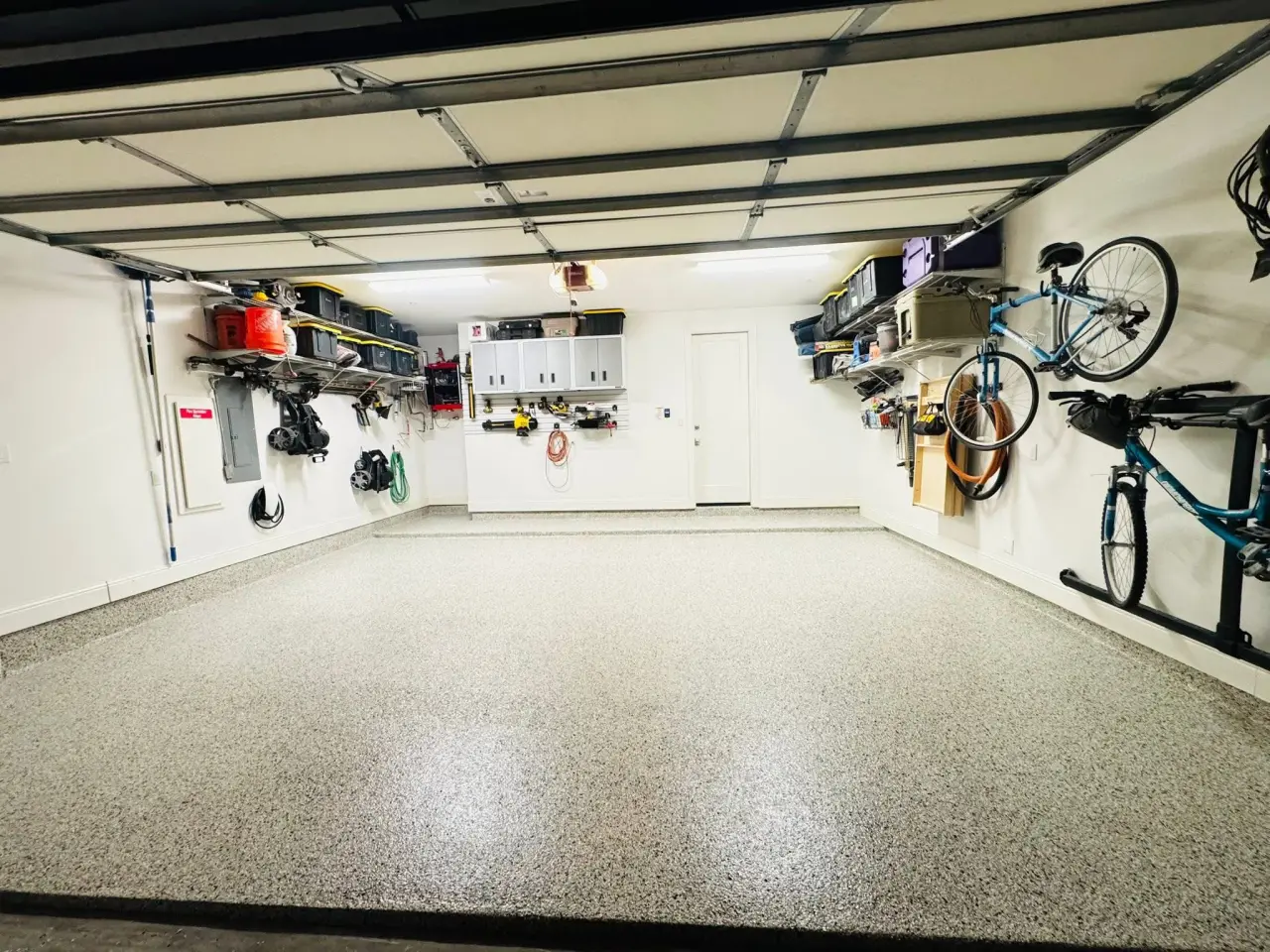
“Epoxy floor” is often used as a catch-all phrase. In reality, a finished garage floor is a system: the existing slab, its preparation, any repairs or primers, the coating layers, decorative flakes if used, and the final protective coat. Houston heat, frequent humidity, and everyday garage traffic make the details matter.
The short version: do not choose an installer on color chips or a one-line price alone. Ask how the slab will be evaluated and prepared, what system is being specified, and when the floor can safely return to service.
1. The concrete has to be evaluated, not just cleaned.
Paint, oil, curing compounds, hardeners, old sealers, loose concrete, and weak surface paste can all interfere with adhesion. That is why professional coating guidance focuses on a surface that is clean, sound, and mechanically profiled, not simply swept, pressure-washed, or acid-etched.
The International Concrete Repair Institute (ICRI) uses Concrete Surface Profile, or CSP, as a common way to describe the texture left after preparation. The target profile depends on the coating system. Simiron’s current Simflake SB system guide calls for diamond grinding or shotblasting bare concrete to a CSP 3 or greater profile. That requirement applies to the documented system and should not be treated as a universal setting for every coating.
What matters as a homeowner: the proposal should explain how the floor will be prepared. “We’ll clean it” is not the same as a documented mechanical-preparation step.
2. Moisture is a condition to manage, not something to guess at.
Concrete can hold and transmit moisture even when its surface looks dry. ASTM D4263 exists specifically to indicate capillary moisture in concrete before coating application, because some coating systems can be harmed by moisture at or near the surface.
A plastic-sheet check can be one screening tool, but it is not a one-size-fits-all approval. Product requirements vary. Some systems require specific moisture-meter readings or in-situ relative-humidity testing; others call for a compatible moisture-control primer when readings exceed the base system’s limits. The right answer depends on the selected product and the slab condition.
For Houston garages, this is worth discussing before color selection. It can influence product choice, prep, scheduling, and the long-term risk of bubbling or loss of bond.
3. Sun exposure changes the conversation.
Epoxy is valued for adhesion and chemical resistance, but conventional epoxy can change appearance under ultraviolet exposure. Simiron describes Polyaspartic HS as a UV-stable protective topcoat designed for full-broadcast systems and areas exposed to sunlight. The topcoat still needs to match the complete system and the actual exposure.
That does not mean every garage needs the same topcoat. A fully enclosed garage, a garage that stays open for much of the day, a covered patio, and a driveway apron have different exposure. The useful question is: which layer of this system is intended to handle sunlight, and where will it be used?
4. Cracks and joints need an honest plan.
Small static cracks can often be repaired as part of a coating project, but not every line in a slab should be treated the same way. Control joints and expansion joints are intentional movement locations. Filling over a moving joint without a compatible detail can lead to a visible crack in the coating later.
A good site visit distinguishes cosmetic cracks, structural concerns, control joints, and areas of spalling or weak concrete. If there is uncertainty about a slab’s condition, it should be addressed before a finish is promised.
5. “Ready tomorrow” is not a universal promise.
Cure time depends on the chemistry, number of coats, film thickness, temperature, humidity, and the manufacturer’s instructions. A floor may be dry to the touch before it is ready for vehicle traffic. Fast-return systems exist, but the schedule still needs to follow the exact product data and site conditions.
Ask for separate expectations for walking, moving light items back in, and parking a vehicle. A clear answer protects the new floor during its most vulnerable stage.
Questions worth asking any installer
- How will you inspect the slab for contamination, weak concrete, cracks, and moisture?
- What mechanical preparation method and surface profile does the specified system require?
- What are the primer, color or broadcast, and topcoat layers? What does each one do?
- How are cracks and control joints being handled?
- What is the product-specific return-to-service schedule for foot traffic and vehicles?
- What work is included in the written scope, and what slab conditions could change it?
The bottom line
A durable garage floor is not about a lifetime promise. It is about matching the system to the concrete, exposure, and use of the space, then being specific about preparation. That work is mostly invisible once the floor is finished, but it gives the system its best chance to perform.
This article is general education, not a diagnosis of a specific slab. A site evaluation and the selected manufacturer’s current technical data should guide an actual project.
Want a clear recommendation for your garage?
Talk with Carnar Epoxy about the slab, the finish you want, and the best next step for your space.
Request a free estimate